The Platform for
HIPAA Compliance

Confidently meet HIPAA compliance requirements across your entire organization. Compliancy Group structures healthcare compliance programs by bringing your training, policies, and risk assessments into one platform, so you’re less reactive and more confident in your HIPAA compliance program.
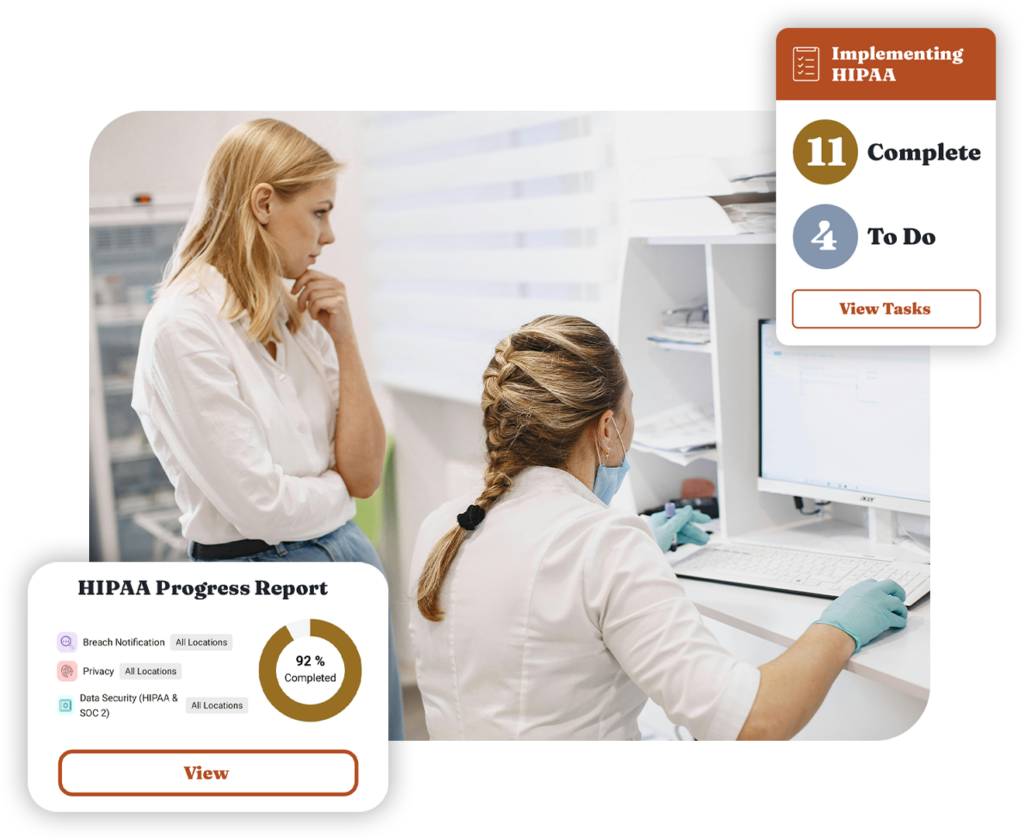
hipaa compliance platform in use with floating ui elements

HIPAA Library for Employee Training

See Who’s Trained, Without Chasing Anyone Down

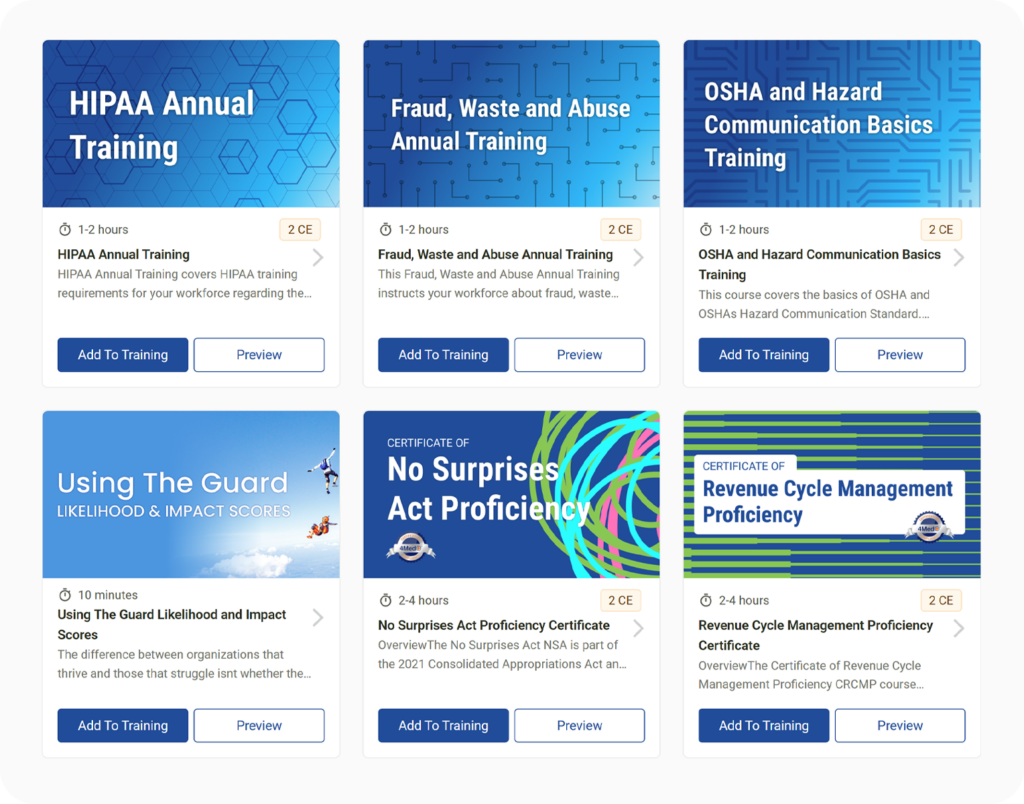
A HIPAA training library that gets your workforce up to speed with engaging and effective courses. Every completion and certificate lands in one record automatically, giving you real-time visibility into where each employee stands.
  • HIPAA Privacy Rule essentials

  • Security Rule & ePHI handling

  • Breach notification

  • Right of Access (30-day SLA)

  • Telehealth & mobile devices

  • Social media & HIPAA

  • Role tracks: clinical, IT, billing

  • Certificates & CE credit exports

healthcare compliance training course catalog
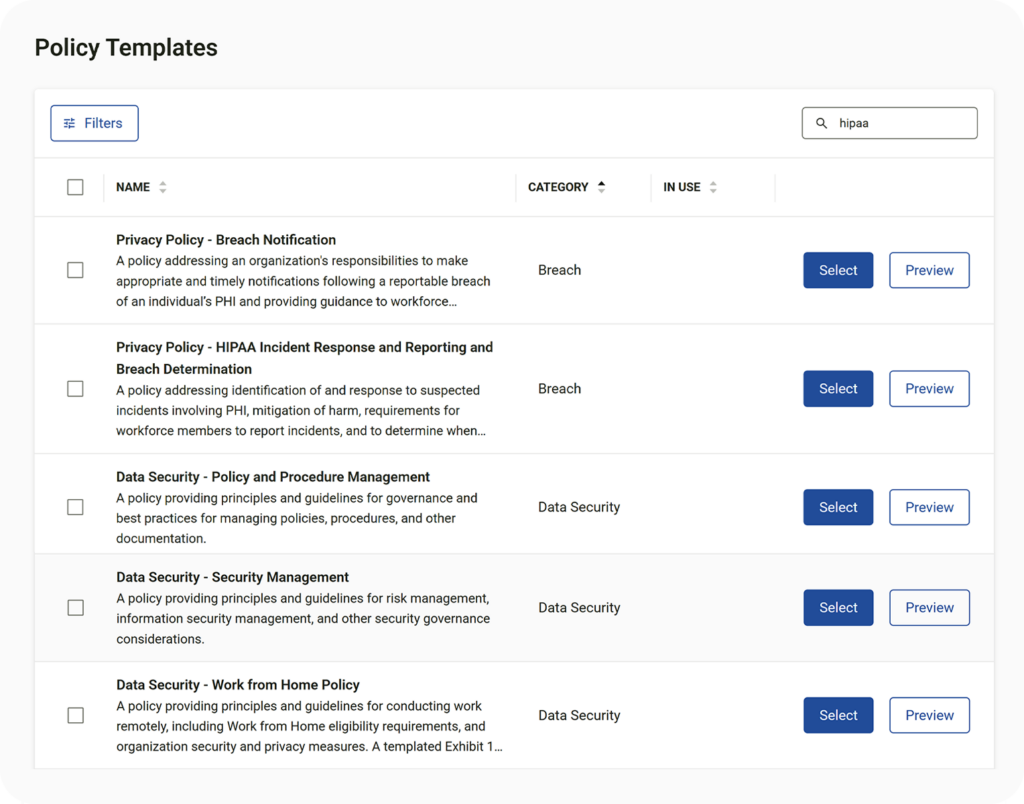
hipaa compliance policy library

HIPAA Policies & Procedures

Know Which Policies You Actually Need

Stop distributing policies blindly to employees who don’t read them. The Guard keeps you compliant by helping you understand which policies you need to use, and it makes it simple to ensure every employee reviews and attests, every time.
Guides for HIPAA Compliance

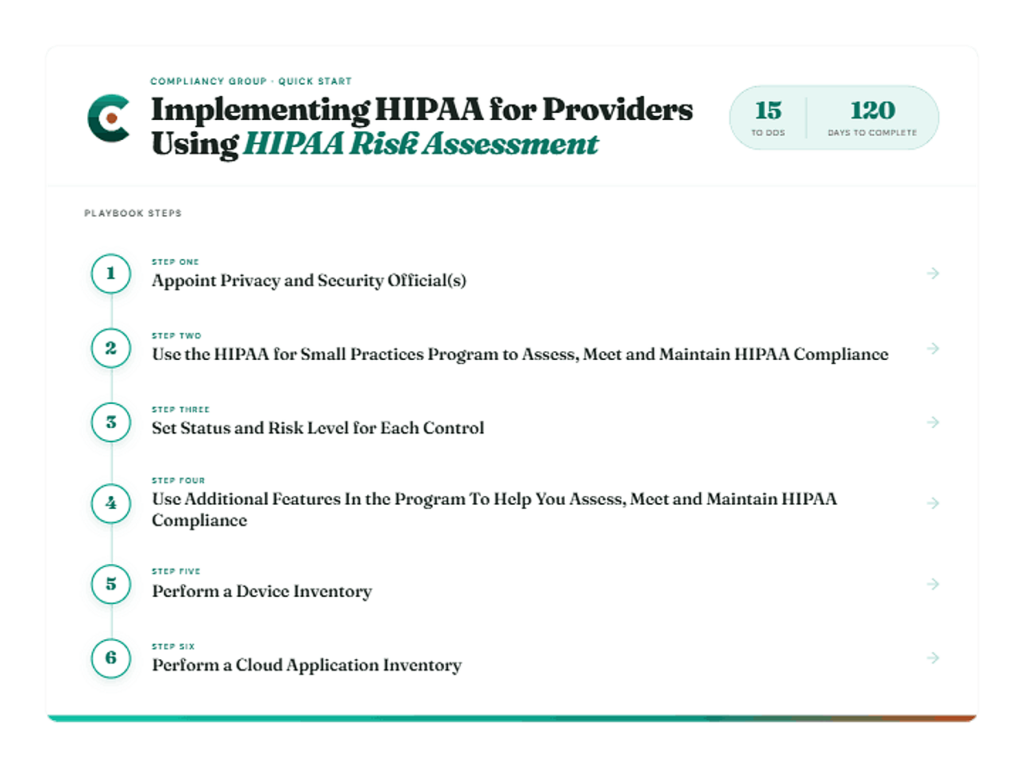
Start Your Risk Assessment With a Clear Plan

Not knowing where to begin is often the hardest part of a risk assessment. The Compliancy Group platform breaks it down into a specific set of tasks based on where your organization actually stands.

hipaa compliance playbook implementation list

Compliance Confidence, Even as Rules Change

HIPAA enforcement keeps getting stricter. The Compliancy Group platform stays current on its own, so you don’t need to track every regulatory update.

One Platform for the Whole Compliance Program

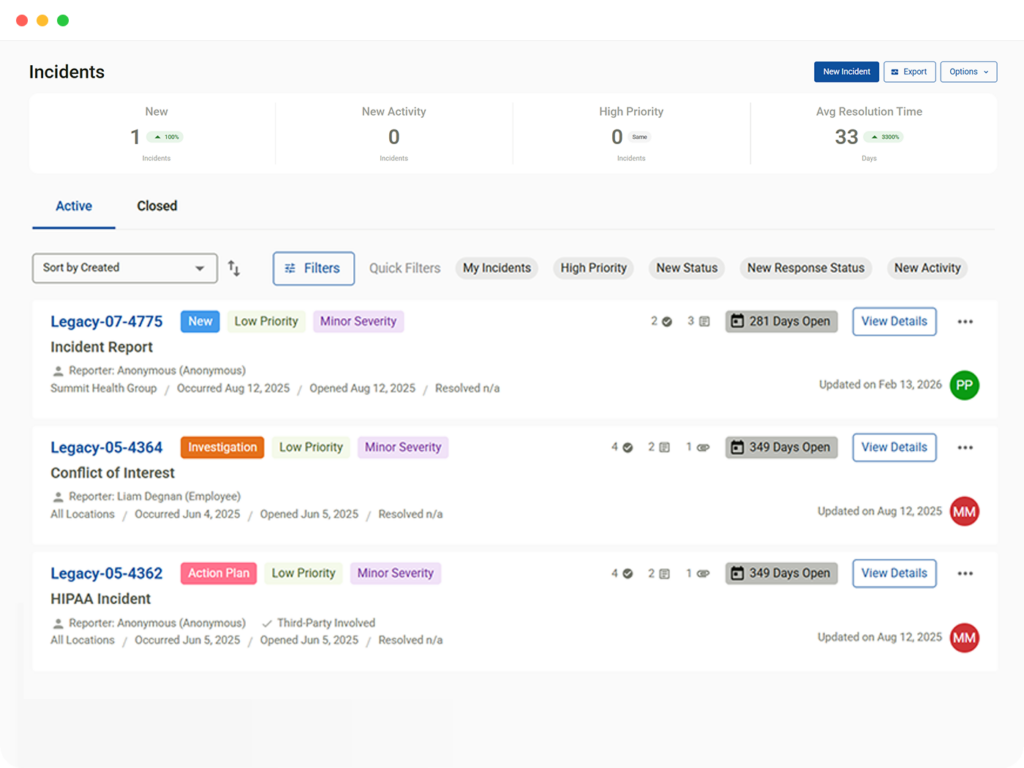
Workforce training, risk assessments, incident response, vendor oversight. Most organizations run these as separate efforts, and that gap is usually where risk sneaks in. The Compliancy Group platform connects them, so problems don’t slip through unnoticed and turn into fines.
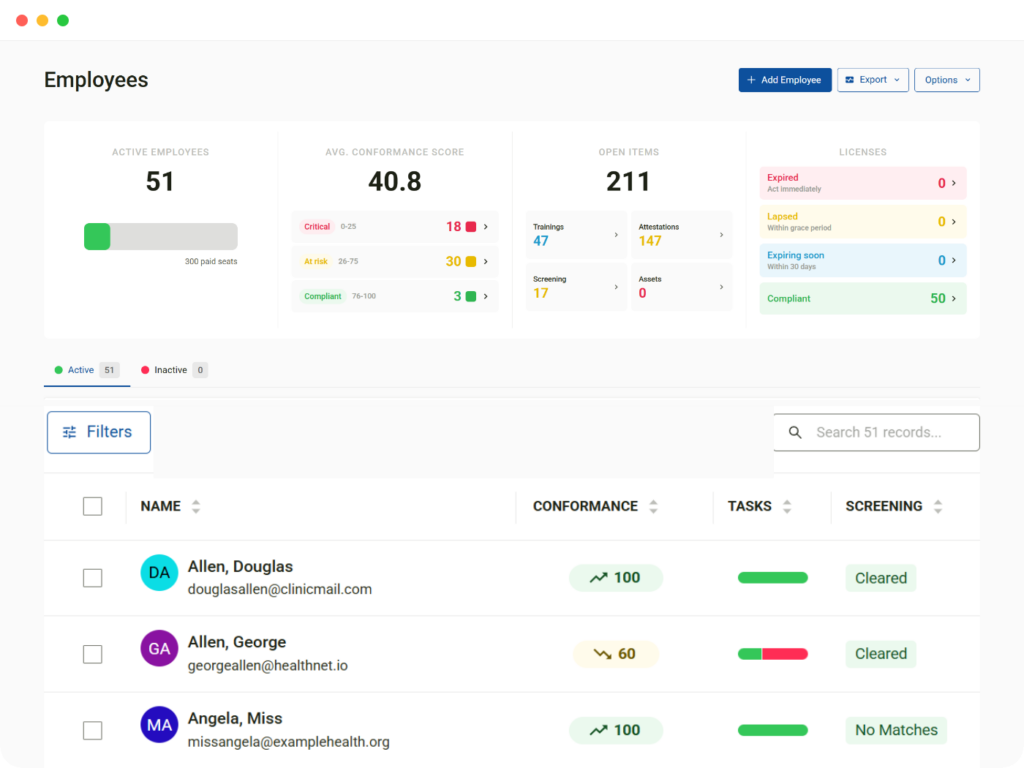
Strengthen Workforce Compliance

Track training, policy sign-off, sanction screening, and required documents for every employee, all in one place. See who’s covered and who isn’t without checking five different systems.

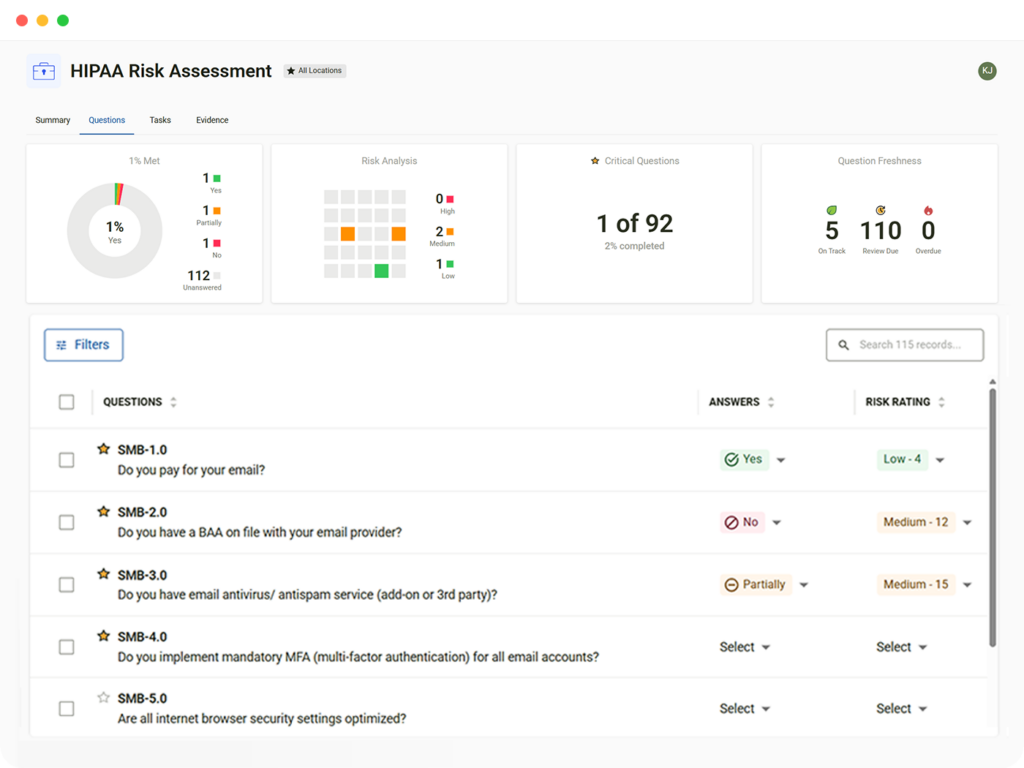
Assess & Minimize Risk

Find and fix risk before it turns into a real problem. Guided workflows in the platform help you assess and address risk with confidence.

Track Incidents Responsibly

Give patients, employees, and anonymous sources a hotline to report incidents, and manage every case through a guided process that leaves you with a defensible record.

Manage All Your Third-Party Risk

Your vendors carry your risk too. The Compliancy Group platform makes vendor oversight simple, with every relationship managed in one place.

“I appreciate knowing that we are in compliance with HIPAA regulations. I tried doing this on my own and it was so complex and time consuming it completely interfered with my ability to actually run my practice.”

AN

Alicia Nixon

Garner Physical Therapy Center

Frequently Asked Questions

HIPAA, Answered

HIPAA compliance software is a platform that helps covered entities and business associates meet the requirements of the HIPAA Privacy, Security, Breach Notification, and Enforcement Rules. It typically centralizes workforce training, policies and procedures, security risk assessments, business associate agreement (BAA) tracking, and incident management, producing the documentation needed to prove compliance during an OCR audit or investigation.

The Compliancy Group platform includes all of the above, plus a training library maintained by compliance experts that updates as the rules evolve.

HIPAA applies to two groups:

Covered entities — most healthcare providers, health plans, and healthcare clearinghouses.

Business associates — any vendor, contractor, or subcontractor that creates, receives, maintains, or transmits Protected Health Information (PHI) on a covered entity’s behalf. This includes IT vendors, billing companies, MSPs, cloud providers, and software companies serving healthcare customers.

Solo practices, small clinics, and large hospital systems all qualify if they handle PHI. OCR has penalized organizations of every size, including solo practitioners.

At a minimum, complete HIPAA compliance software should include:

(1) annual workforce HIPAA training with completion tracking and attestations, (2) a complete library of HIPAA policies and procedures, (3) the six required Security Rule risk assessments, (4) Business Associate Agreement management, (5) incident reporting with hotline and audit-trail tracking, and (6) ongoing regulatory updates as the rules change.

The Compliancy Group Platform includes all six, plus role-based playbooks for the moments compliance actually gets tested, including breach response, OCR audits, and patient record requests.

The HIPAA Privacy Rule (45 CFR § 164.530(b)) requires training for new workforce members and “as necessary and appropriate” thereafter. The Security Rule (45 CFR § 164.308(a)(5)) requires an ongoing “security awareness and training program” for all workforce members.

Most covered entities meet both requirements with annual HIPAA training and OCR has consistently treated annual training as the de facto standard during enforcement actions. Inadequate training is one of the most common findings in OCR investigations.

As of January 28, 2026, HIPAA civil monetary penalties range from $145 to $2,190,294 per violation, depending on the level of culpability across four tiers (lack of knowledge, reasonable cause, willful neglect-corrected, willful neglect-not corrected).

A single breach can be charged across multiple violation categories, and a systemic failure (such as never conducting a Security Risk Assessment) can be treated as a separate violation for every day it persisted. Individual employees can also face criminal penalties of up to $250,000 and 10 years in prison for willful violations involving theft or commercial misuse of PHI.

A Security Risk Assessment (SRA) is required under 45 CFR § 164.308(a)(1)(ii)(A) of the HIPAA Security Rule. It’s an enterprise-wide evaluation of risks and vulnerabilities to the confidentiality, integrity, and availability of electronic Protected Health Information (ePHI), and it drives the remediation plan that closes those gaps.

Failure to conduct an accurate, comprehensive SRA is the single most common finding in OCR enforcement actions. The Guard breaks the SRA into yes/no questions, surfaces the gaps, and auto-generates remediation tasks for each one.

On January 6, 2025, HHS published a Notice of Proposed Rulemaking (NPRM) to modify the HIPAA Security Rule for the first time since 2013. Proposed changes include:

Mandatory encryption of ePHI at rest and in transit; multi-factor authentication for ePHI access; network segmentation where reasonable; an asset inventory of all systems handling ePHI; vulnerability scans every six months and annual penetration testing; and a 72-hour incident response requirement.

The comment period closed March 7, 2025. A final rule is anticipated in 2026, with most regulated entities expected to have 180 days to comply once it’s published.

You can use Compliancy Group’s templated policies, upload your own, or any combination. The platform tracks attestations, version history, and review cycles either way.

If you’ve been managing compliance in spreadsheets, you can import them and continue from where you are.

Yes. HIPAA training with continuing education (CE) credit is included with your subscription, including core training, role-based modules, and the regulatory updates that keep them current.

Premium training tracks with additional certifications are available at additional cost.

Yes. The HIPAA library is reviewed weekly against federal and state regulatory feeds. When OCR issues new guidance, when penalty amounts adjust for inflation, or when a new final rule takes effect, the affected training, policies, and playbooks are updated and pushed to customers automatically.

The most recent example: HHS raised civil monetary penalty amounts on January 28, 2026. Customers were notified within 48 hours and the policy library reflected the new ranges by the following Monday.

Everyone from solo practitioners to enterprise health systems. Plus business associates including IT vendors, MSPs, billing companies, SaaS platforms, and cloud providers serving healthcare. Your compliance program is tailored to your size, role, and risk profile.

Build a Complete Compliance Program In One Platform