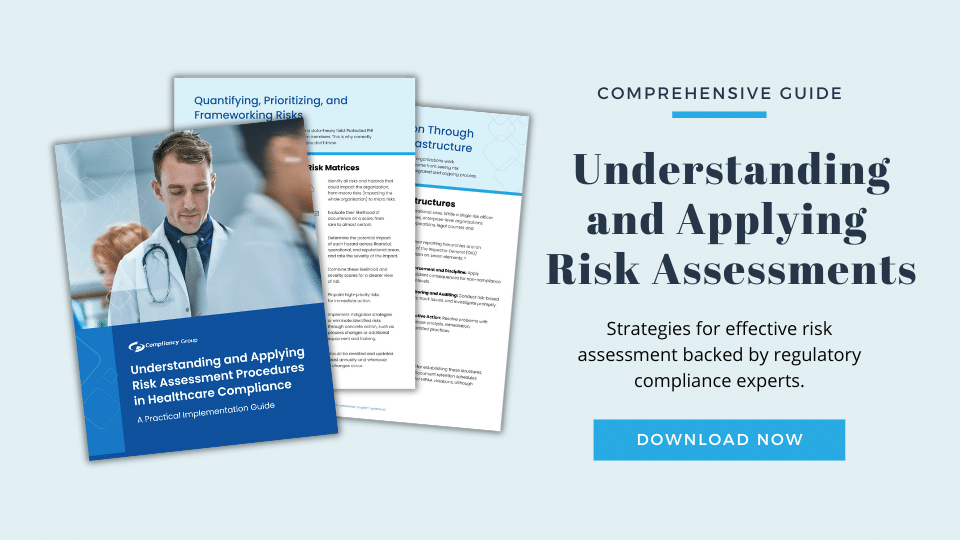
Our free tools and educational resources come from the top compliance experts in the country who are working with us to help you succeed. The healthcare compliance resources below give you the tools you need to start assessing your compliance status. Please feel free to download and utilize our healthcare compliance resources – or contact us directly if you have any questions about becoming compliant.






Stay Updated on the Latest Compliance News
Understanding How the OIG LEIE Affects Your Business
The Office of Inspector General (OIG) maintains the List of Excluded Individuals and Entities (LEIE) as a useful tool that helps safeguard federal healthcare programs from both fraud and abuse. Additionally, the [...]
Change Healthcare Class Action Lawsuit to Proceed in Federal Court
In February of 2024, Change Healthcare (Change), a healthcare payment processing company, sustained a data breach. This data breach was no ordinary data breach (to the extent a data breach can be [...]
The OCR HIPAA Audit Program and the HIPAA Security Rule
The HITECH Act requires the Department of Health and Human Services’ (HHS) Office for Civil Rights (OCR) to conduct periodic audits of HIPAA covered entity and business associate compliance with the HIPAA [...]
2024 OIG General Compliance Program Guidance
The U.S. Office of Inspector General (OIG) enforces the General Compliance Program Guidance. This comprehensive document governs patient care, worker safety, and privacy and confidentiality of protected health information (PHI). In November, [...]
9.67 Million Affected by August 2024 Healthcare Breaches
August 2024 was a record month for healthcare breaches. Healthcare providers reported the most breaches, but one business associate reported a massive breach, tipping the scales to the most affected group of [...]
Texas Lawsuit Seeks Invalidation of HIPAA Reproductive Healthcare Privacy Rule
On April 22, 2024, the Department of Health and Human Services’ (HHS) Office for Civil Rights (OCR) issued a Final Rule, entitled “HIPAA Privacy Rule to Support Reproductive Health Care Privacy.” [...]