Your New Solution to
OSHA Compliance.

Confidently meet HIPAA compliance requirements across your entire organization. Simple, user friendly tools assign training, guide assessments, and prove compliance with less effort and greater certainty.

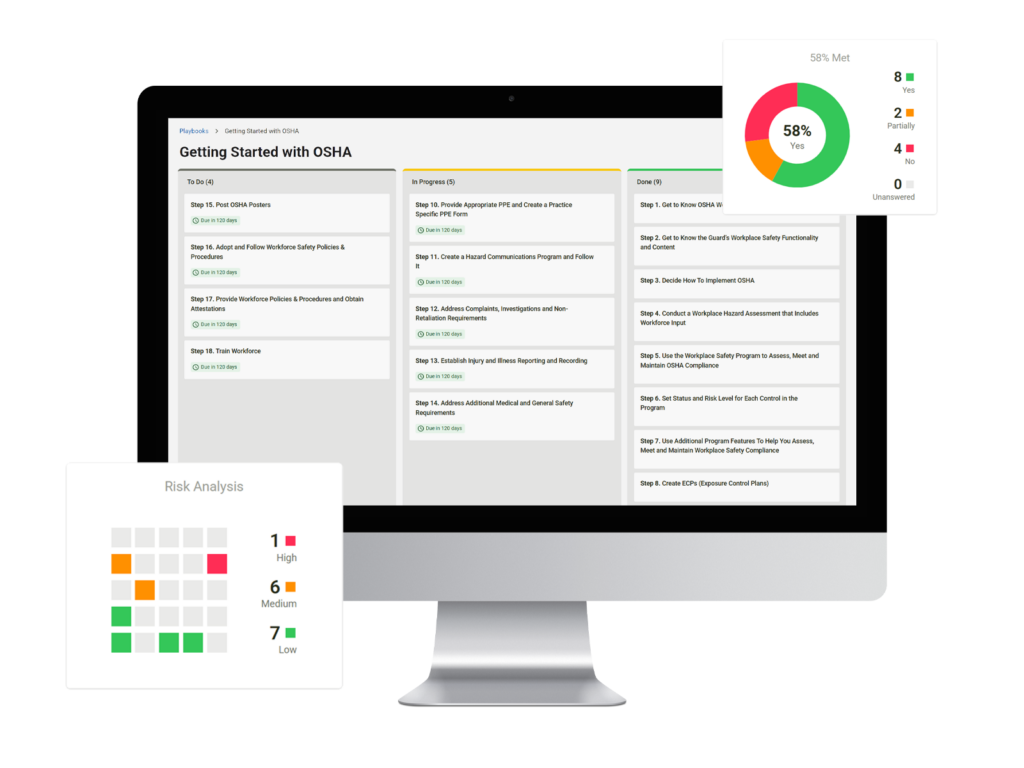
osha compliance dashboard for healthcare

OSHA Training for Healthcare Compliance

OSHA Training can be Easy & Effective.

Protect your employees, patients, and business with training that’s engaging, easy to administer, and simple to track—and prove to auditors. Make your life easier and your business safer with the most complete and targeted OSHA training on the market.
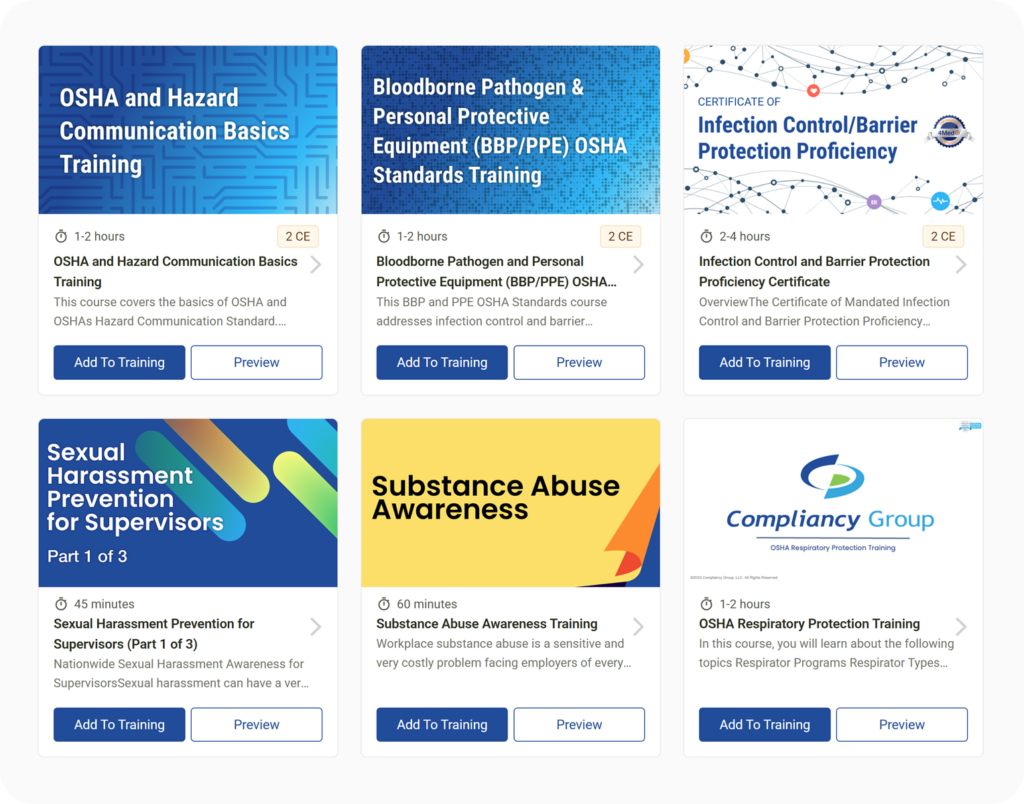
OSHA training lms course catalog
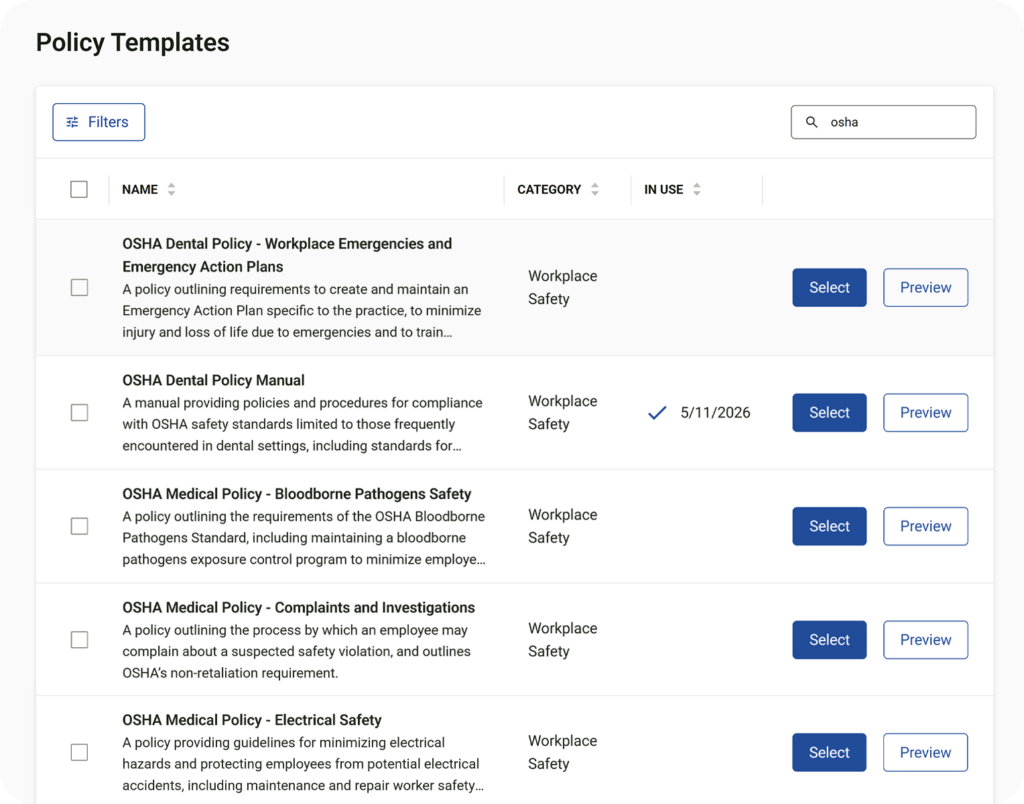
library of osha policies for healthcare compliance

OSHA Policies & Procedures

Are Your OSHA Policies Regulator-Proof?

The right OSHA policies protect people from accidents, and businesses from penalties. The wrong policies? They don’t protect anyone. Compliancy Group helps you select and deliver the right policies to the right people, whether you understand OSHA or not. It also records policy delivery and attestation, so your efforts are always obvious to regulators.

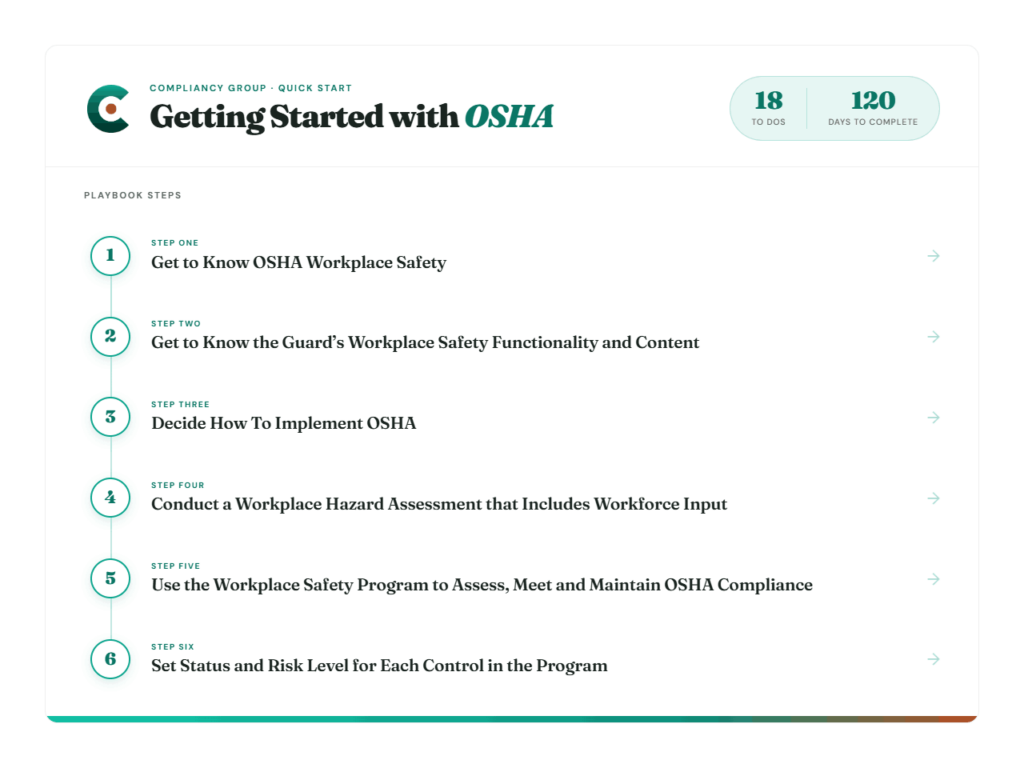
Step-by-Step OSHA Playbooks & Plans

A Simple Way to Manage OSHA Compliance, for Everyone.

The right OSHA policies protect people from accidents, and businesses from penalties. The wrong policies? They don’t protect anyone. Compliancy Group helps you select and deliver the right policies to the right people, whether you understand OSHA or not. It also records policy delivery and attestation, so your efforts are always obvious to regulators.
OSHA Doesn’t Email You When the Rules Change.

Regulation never stands still, and enforcement keeps getting more aggressive. All the training, guidance, policies, and playbooks in The Guard are updated continuously, so you never have to worry about falling behind. Your compliance program is always up to date, no additional effort required.

OSHA isn’t Your Only Challenge.

An OSHA program only protects you from one of the many regulators and government agencies who scrutinize your organization. The Guard covers every corner of your compliance activities with less effort than you’re already putting into OSHA alone. Complete compliance isn’t as hard as it looks.
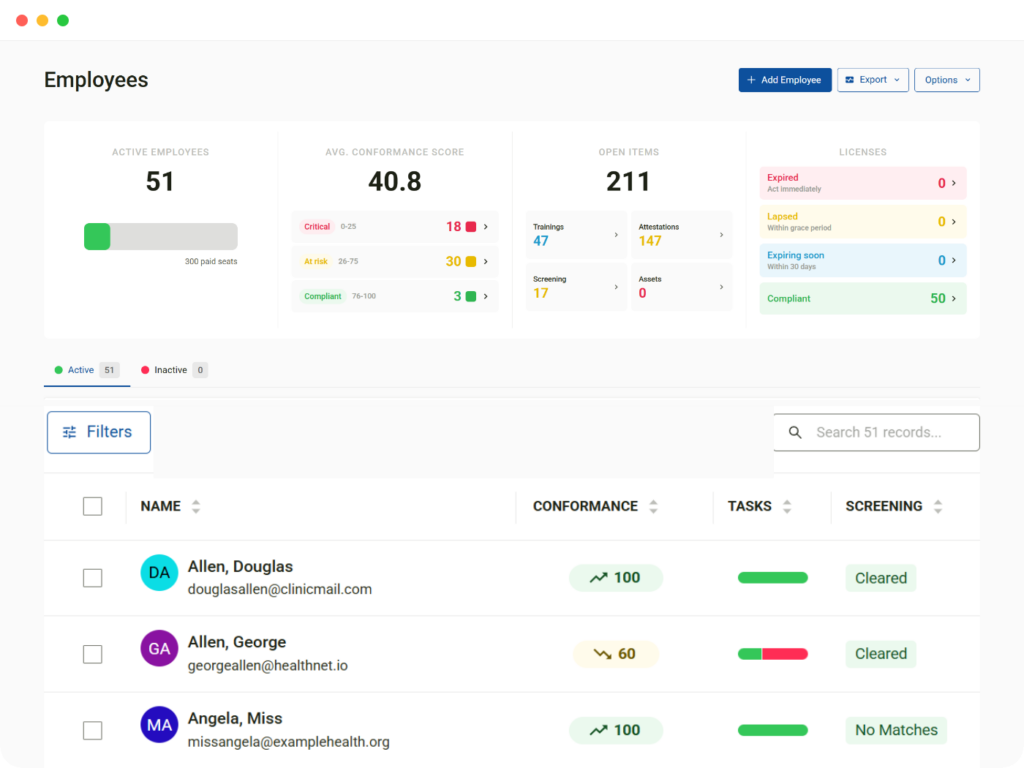
Build a Safer Workforce

Train, monitor, and manage your entire workforce with a set of tools that makes compliance so intuitive, it becomes the default—not just another chore.

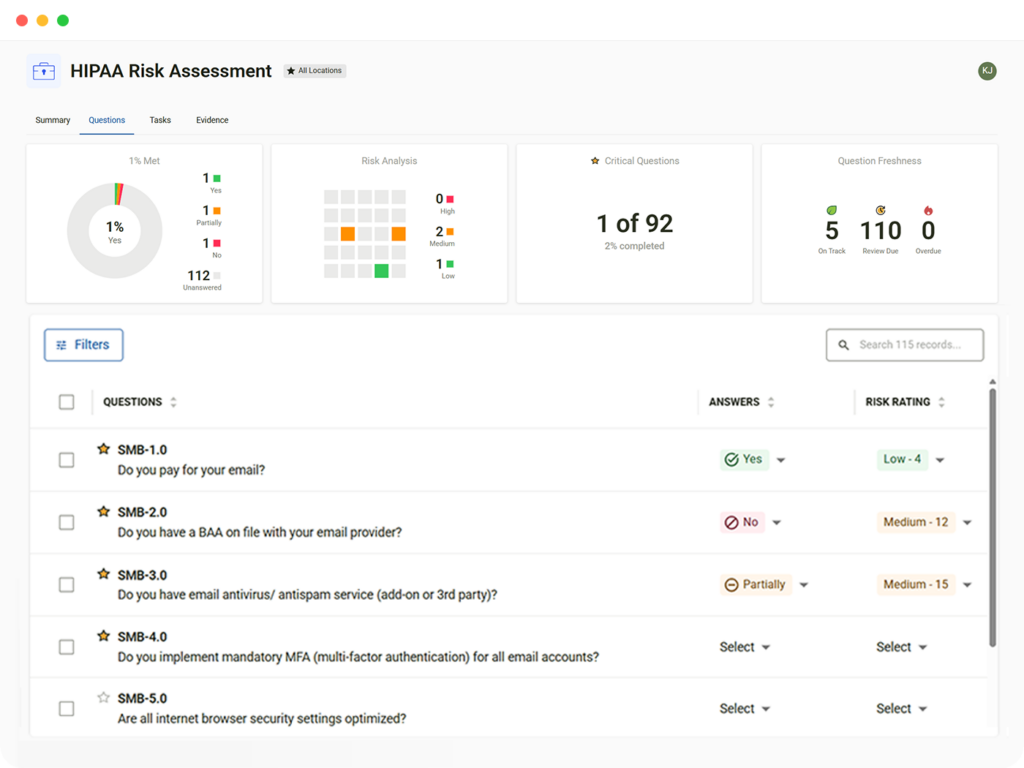
Understand & Minimize Risk

Identify and resolve risk in a system that keeps patients safe and regulators happy. Compliancy Group guides you through every step you need to take.

Track Incidents Responsibly

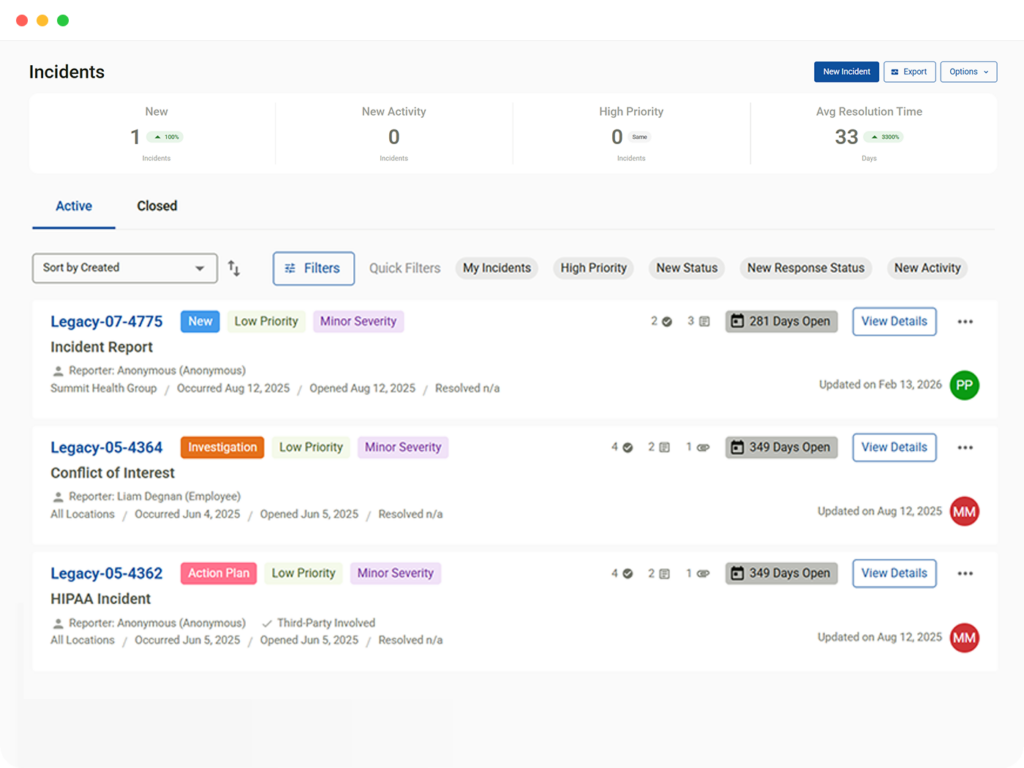
Incidents are only scary if they go unreported, and unresolved. Track and manage incidents correctly, without adding needless layers of administration.

Manage All Risk Sources

Don’t let third parties jeopardize your business. Compliancy Group simplifies the task of managing vendor risk, so you can feel secure in your business relationships.

“To have all compliance related data in one place is extremely helpful. To be able to see which policies and trainings have been assigned, to whom and to track progress easily has been very useful.”

KA

Kim Andrzejewski

ProCure, LLC

Frequently Asked

HIPAA, answered.

The questions our customers ask most often—answered with the same care a coach would give you on a kickoff call.

For healthcare employers, OSHA compliance software pulls everything an Occupational Safety and Health Administration inspector might ask for into a single platform. That includes annual workforce training, written programs, injury and illness recordkeeping, Safety Data Sheet (SDS) management, sharps injury logs, and hazard assessments.

The point is to have current, signed, dated documentation ready before an inspection — not after one. Compliancy Group’s platform, The Guard, was built around that single idea.

Yes. OSHA applies to nearly every healthcare employer in the United States, including hospitals, physician practices, dental offices, ambulatory surgery centers, urgent care, behavioral health, long-term care, home health agencies, and laboratories.

Healthcare workers face some of the highest occupational injury rates of any industry—exposure to bloodborne pathogens, hazardous drugs, ergonomic hazards from patient handling, and workplace violence are all OSHA-regulated. Twenty-two states operate their own OSHA-approved State Plans that may impose additional requirements on top of federal OSHA.

The most commonly cited OSHA standards in healthcare include:

Bloodborne Pathogens (29 CFR 1910.1030), Hazard Communication (29 CFR 1910.1200), Personal Protective Equipment (29 CFR 1910.132), Respiratory Protection (29 CFR 1910.134), Recordkeeping (29 CFR 1904), Emergency Action Plans (29 CFR 1910.38), and Ionizing Radiation (29 CFR 1910.1096).

Workplace violence prevention and ergonomics are enforced under the General Duty Clause (Section 5(a)(1) of the OSH Act) until specific standards are finalized.

It depends on the standard. Bloodborne Pathogens training (29 CFR 1910.1030) is required at initial assignment and at least annually thereafter. Hazard Communication training is required at initial assignment and whenever a new chemical hazard is introduced. PPE training is required when an employee is first assigned a task requiring PPE and whenever the workplace, equipment, or PPE changes. Respirator users must be retrained and fit-tested annually.

Most healthcare employers run a single annual training cycle to cover all OSHA-required topics for their workforce. The Guard automatically schedules and tracks all of these.

As of January 15, 2025 (with figures applicable in 2026), OSHA’s maximum civil penalties are $16,550 per violation for serious or other-than-serious violations, $16,550 per day beyond the abatement date for failure to abate, and $165,514 per violation for willful or repeated violations. Penalties are adjusted annually for inflation.

State Plan states are required to set penalties at least as effective as federal OSHA. A single inspection can produce multiple citations, and a willful violation that results in a worker’s death can also trigger criminal referrals to the U.S. Department of Justice.

The Bloodborne Pathogens Standard (29 CFR 1910.1030) protects workers with reasonably anticipated exposure to blood or other potentially infectious materials (OPIM). It requires a written Exposure Control Plan reviewed and updated at least annually, the use of engineering and work practice controls, free hepatitis B vaccination for at-risk workers, post-exposure evaluation and follow-up, annual training, and a sharps injury log.

It is consistently among the most-cited OSHA standards in healthcare. The Needlestick Safety and Prevention Act of 2000 added requirements to evaluate safer needle devices and involve frontline workers in the selection process.

Yes—through the General Duty Clause. There is no specific federal OSHA standard for workplace violence prevention yet, but OSHA has cited and continues to cite healthcare employers under Section 5(a)(1) of the OSH Act for failing to protect workers from a recognized hazard.

OSHA’s 2026 regulatory agenda includes a proposed Workplace Violence Prevention Standard for Healthcare and Social Assistance, currently in long-term action status. Several states (notably California and New York) already have their own enforceable workplace violence prevention requirements for healthcare. OSHA’s published Guidelines describe five expected program elements: management commitment, worksite analysis, hazard prevention and control, training, and recordkeeping.

Under 29 CFR 1910.1030(c), the Exposure Control Plan must include an exposure determination listing job classifications and tasks with anticipated exposure, the schedule and method for implementing each requirement of the standard, and a procedure for evaluating exposure incidents.

The plan must be reviewed and updated at least annually, and updated whenever new tasks or procedures affect occupational exposure. Frontline workers responsible for direct patient care must be solicited for input on the selection of safer engineering controls. The Guard provides a templated ECP and tracks the annual review automatically.

These are OSHA’s required injury and illness recordkeeping forms.

Form 300 is the Log of Work-Related Injuries and Illnesses (kept on a rolling basis throughout the year). Form 301 is the Injury and Illness Incident Report, completed within seven calendar days of each recordable case. Form 300A is the Annual Summary, which must be posted in a visible workplace location from February 1 through April 30 of the year following the records.

Healthcare establishments with 100+ employees in designated high-hazard industries are also required to electronically submit Forms 300 and 301 data to OSHA each year.

On May 20, 2024, OSHA published a final rule modifying the Hazard Communication Standard (29 CFR 1910.1200) to align with Revision 7 of the United Nations Globally Harmonized System (GHS). Key changes include updated criteria for classifying certain health and physical hazards, revised label requirements (including small container labeling), updated Safety Data Sheet content, and clearer rules for combustible dusts and concentration ranges.

Most provisions took effect July 19, 2024, with manufacturer compliance required by January 19, 2026, and downstream employer compliance—training and workplace labeling updates—required by July 20, 2026.

You can use Compliancy Group’s templated written programs, upload your own, or any combination. The Guard tracks attestations, version history, and review cycles either way.

If you’ve been managing OSHA in binders or shared drives, you can import your existing Exposure Control Plan, HazCom Program, and injury logs and continue from where you are. The library doesn’t force a do-over—it picks up where you left off.

Professional and Enterprise tiers include a dedicated onboarding coach during your first 90 days, plus ongoing access to a Customer Success Manager for strategic guidance.

Essential-tier customers receive quick-start guides for self-onboarding plus chat and email support. All tiers have access to our U.S.-based technical support team.

Yes. The full healthcare OSHA training library is included with The Guard—Bloodborne Pathogens, Hazard Communication, PPE, Workplace Violence Prevention, Tuberculosis Exposure Control, Ergonomics and Safe Patient Handling, Fire Safety, and Emergency Action.

Courses are offered as audiobook, text, and video, with quizzes, certificates, and continuing education (CE) credit where applicable. Premium clinical and specialty tracks are available at additional cost.

Yes. When OSHA issues new guidance, when penalty amounts adjust for inflation, or when a new final rule takes effect, the affected training, written programs, and playbooks are updated and pushed to customers automatically—no version-tracking required on your end.

The most recent example: the 2024 HazCom alignment with GHS Revision 7. Customers were notified within 48 hours of publication, and the policy library reflected the new label and SDS requirements before the employer training deadline approached.

Everyone from solo dental practices to enterprise health systems—plus specialty settings such as ambulatory surgery centers, urgent care, behavioral health, long-term care, home health, and clinical laboratories. Your OSHA program is tailored to your size, setting, and hazard profile.

The platform is fully cloud-based; nothing to download or install.

Work Safer, Smarter, & Faster.