Healthcare Compliance Plan Best Practices: How to Write One That Works



A healthcare compliance plan is the written document that describes how your compliance program works. The two terms are often used interchangeably, but they aren’t the same. Your compliance program is the ongoing work: training staff, checking for problems, taking reports, and fixing what you find. The plan is the blueprint for that work. It lists the laws that apply to you, who is in charge of compliance, and how each part of the program runs. Regulators judge whether the program works, and the plan is usually the first thing they ask to see.
A compliance plan also isn’t a one-time project. It works best as a yearly cycle: assess your risks, confirm which laws apply, update your policies and training, check that the work is getting done, and get leadership to approve the updated plan. The HHS Office of Inspector General (OIG) recommends doing several of these steps at least once a year, so the cycle gives you a built-in schedule. Many plans are instead written once, often from a template, and set aside. Over time, the policies stop matching how work gets done, and records end up spread across inboxes, spreadsheets, and shared drives. This guide shows you how to build your plan around OIG’s seven elements, run it as a yearly cycle, and show that it’s working.


How OIG’s Seven Elements Shape Your Healthcare Compliance Plan
Many compliance plans start the same way: a deadline, a template, and a long list of rules that may or may not apply to you. OIG’s seven elements help you sort that out. They give your plan a structure that regulators and auditors already know.
OIG laid out the elements in its General Compliance Program Guidance (GCPG), published in November 2023. Following it is voluntary, and it’s meant to fit organizations of any size. A small practice can meet the elements with a lighter setup, while a larger organization will need more structure. OIG has also begun publishing industry-specific guidance (ICPGs) that builds on the GCPG, starting with nursing facilities in November 2024 and Medicare Advantage in February 2026, so check whether one applies to you. Using the elements as the main sections of your plan also makes it easier for anyone to find what they need.
The table below shows how each program element should appear in your plan. For more detail on each one, see our guide to the OIG 7 elements of an effective compliance program.
| OIG element | What your plan should describe |
|---|---|
| 1. Written policies and procedures | Your code of conduct and the policies for your main risk areas, with a schedule for reviewing them |
| 2. Compliance leadership and oversight | Who serves as compliance officer, who sits on the compliance committee, and how leadership and the board stay informed |
| 3. Training and education | Who is trained on what, and how often |
| 4. Effective lines of communication with the compliance officer and disclosure programs | How staff ask questions and report concerns, including anonymously, and how reporters are protected from retaliation |
| 5. Enforcing standards: consequences and incentives | How violations are handled consistently, and how good compliance work is recognized |
| 6. Risk assessment, auditing, and monitoring | How you identify your risks and check that controls are working |
| 7. Responding to detected offenses and developing corrective action initiatives | How you investigate problems and confirm that fixes are completed, including how you report and return overpayments and when you self-disclose |
Treat the plan as a yearly project. Each cycle starts with a risk assessment so you know where to focus. Next, confirm the laws that apply to you and update the policies and training that address them. Then decide how you’ll check your work, take reports, and fix problems, and set the dates for each task. Close the cycle by getting leadership to approve the updated plan. What you learn during the year, from audits, reported concerns, and corrective actions, becomes the starting point for next year’s risk assessment.
If you’d like more help structuring each section, our Healthcare Compliance eBook walks through how to follow OIG’s seven elements.
Compliance Plan Best Practices to Consider
A template gives you a place to start. Whether people use the plan depends on how well it fits your organization.
Across the single practices and multi-site groups we work with, the plans that work best have two things in common. They’re written for that organization, and they’re clear about who does what. The compliance plan best practices below build on those two ideas.
Start With a Risk Assessment
Most templates start with policies, so it’s tempting to start there too. Doing a risk assessment first shows you which policies matter most and where to spend your limited time. OIG recommends a compliance risk assessment at least once a year, led by the compliance committee. If you don’t have a committee, the job falls to whoever handles compliance. Sitting down once a year with the owner or administrator to review your main risk areas is a good place to start.
One gap comes up often. Many organizations do a HIPAA security risk analysis and treat it as their whole risk assessment. HIPAA does require that analysis (45 CFR 164.308(a)(1)(ii)(A)), but it only looks at how you protect electronic protected health information (ePHI). Privacy Rule risks (such as paper records, verbal disclosures, and patient access requests), billing, coding, referrals, and workplace safety need their own review. Your plan should list both assessments, when each one happens, and who is responsible. Our guide on how to complete a risk assessment walks through the process.
Size the Plan to Your Organization and the Laws That Apply
Your plan should fit the size of your organization. A small practice can name one person as its compliance contact instead of building a department. A multi-site group or hospital usually needs a compliance committee, and OIG recommends that it meet at least every three months. The list of rules is often longer than people expect. Many plans mention HIPAA and stop there. If you bill Medicare or Medicaid, your plan also needs to cover the federal fraud and abuse laws. These include the Anti-Kickback Statute, the Stark law on physician self-referrals, the False Claims Act, and the Civil Monetary Penalties Law, which also covers improper inducements to patients. Your payer contracts may add their own rules. So may state law: many states have their own anti-kickback, self-referral, false claims, and health privacy laws. And in dental and clinical settings, OSHA’s rules on bloodborne pathogens often need as much attention as HIPAA. If you run a federally assisted substance use disorder treatment program, your plan also needs to cover 42 CFR Part 2, the confidentiality rules for those records.
Plans also tend to be vague about exclusion screening, which means checking that staff and contractors aren’t barred from federal health care programs. OIG updates its List of Excluded Individuals/Entities (LEIE) every month. Its 2013 Special Advisory Bulletin on the Effect of Exclusion notes that checking the LEIE monthly minimizes potential overpayment and penalty liability. Many organizations only check at hire, which leaves a gap between checks. Your plan should also cover the federal System for Award Management (SAM.gov) and, where your state has one, its Medicaid exclusion list. Many state Medicaid programs expect providers to screen against their own lists. For more on timing, see our guide on how often to check the OIG exclusion list.
Name Owners and Dates, and Get Leadership Sign-Off
Plans often stall because no one is sure who owns each task. A line like “staff will be trained annually” doesn’t say who sends out the training or when it’s due. Compare that with “The practice administrator assigns compliance training each January and confirms it’s done by March 31.” If you’re a team of one, your name may be on most lines. That’s fine, as long as the plan says so and names a backup.
Leadership sign-off matters too. OIG recommends that the compliance officer report directly to the CEO, with direct access to the board, and that the board gets regular updates on the program. OIG also cautions against having the compliance officer report to, or double as, the general counsel or CFO, since those roles can conflict. In a small practice where that isn’t possible, note in the plan how you manage the overlap. A common practice is to have the CEO sign a short introduction to the code of conduct. When leaders have approved the plan, staff take it more seriously. And you have their support the first time a policy is unpopular.
Make Reporting Easy and Non-Retaliatory
Staff only report concerns when they trust the process. In practice, many concerns never reach the compliance team. Staff mention them to a supervisor, and they’re handled quietly with no record. OIG recommends written policies that protect people who report and keep their reports confidential. This is more than good practice: the False Claims Act (31 U.S.C. 3730(h)) protects employees who act to stop false claims, and HIPAA (45 CFR 164.530(g)) prohibits retaliation against people who file complaints. It also recommends at least one way to report anonymously, such as a hotline, web form, or drop box. Staff shouldn’t have to go through their manager first, so your plan should say clearly that they can go straight to compliance.
Then keep a log of every concern, however it comes in. Note the date, who looked into it, what they found, and how it was resolved. Review the log for trends, not just individual cases, and give the committee or board a regular summary. For more on setting up reporting, see our guide to incident reporting in healthcare.
How to Keep Your Compliance Plan Current
Even a good plan starts to go out of date once it’s approved. Staff come and go, services change, and rules get updated, but the document stays the same. Keeping it current takes three things: a review schedule, a list of events that call for an update, and a record of each version.
Organizations should assign responsibility for overseeing this process to designated individuals or committees who stay abreast of regulatory updates and modify policies accordingly. Write that person’s name in the plan, along with a backup. Plans often stop getting updated when the person who wrote them leaves.
If You’ve Inherited an Existing Plan
Many practice administrators take on compliance with a plan already in place. Before you change anything, find out how current it is. These questions are a good place to start:
- When was it last reviewed? Check the approval date and any review notes. If it’s been more than a year, the plan is due for a review.
- Are the named owners still here? Plans often list people who have left or changed roles. Give each task a current owner and a backup.
- Does it cover the right rules? Compare the laws in the plan with the services you offer and the programs you bill, such as Medicare or Medicaid. If you have clinical areas, check that OSHA requirements are covered too.
- Do the policies match daily work? Walk through a few key policies with the staff who follow them, and note anything that has changed.
- Are the records there? Look for the most recent risk assessment, training records, exclusion screening results, and a log of reported concerns. You don’t have to fix everything at once. Start with the biggest gaps, such as a missing risk assessment or an owner who has left, and work through the rest on a set schedule.
Review the Plan Every Year
OIG recommends reviewing your policies and procedures at least once a year, so they keep up with changes in the law and in federal health care program rules. You can update your risk assessment and training plan at the same time, since OIG recommends doing both yearly too. Some rules have their own deadlines. For example, OSHA requires employers to review and update their bloodborne pathogens exposure control plan at least once a year (29 CFR 1910.1030(c)(1)(iv)). Document each review, including who did it and what changed, even if nothing did.
Update It After Regulatory Changes or Incidents
Some changes can’t wait a year. A new or changed rule is the obvious one. Others are easier to miss: an incident, an audit finding, or a government or payer inquiry that shows a policy isn’t working; a new location or service; a change in ownership or leadership; or a change in a major vendor. Give each of these an owner, so updates don’t depend on someone remembering. If formal approval will take a while, OIG recommends writing down temporary guidance and sharing it with the staff it affects.
Use Version Control
Auditors often ask what a policy said on a specific date. To answer that, save each version with the date it was approved, who approved it, and a short note on what changed. HIPAA requires you to keep Privacy and Security Rule documents for six years from the date they were created or last in effect, whichever is later 45 CFR 164.316(b)(2)(i) and 164.530(j)(2) . Treat six years as a minimum, not a default for everything. Other rules can require longer: Medicare Advantage contracts generally require 10 years, the False Claims Act lookback can reach 10 years, OSHA requires employee exposure and medical records to be kept for the length of employment plus 30 years, and state medical record laws vary. Set each record type to the longest period that applies.
How to Show Your Compliance Plan Is Working
Once the plan is approved, auditors will want records that show people are following it.
For many teams, this is the hardest part. Training records live in one system, incident reports in another, and audit notes in a shared drive. Multi-site groups may have a different setup at every location. So every report to leadership or the board means pulling it all together again. Four types of records matter most:
- Training records. Who finished which training, and when. Include new hires and any refresher training after a policy change. Keep signed acknowledgments of the code of conduct and key policies with them.
- Audit results. What each audit or review checked, what it found, and who looked at the results.
- Corrective actions. Each finding or reported concern, the fix assigned, the owner, and the date it closed.
- Committee minutes. OIG points out that meeting minutes give you a written record of what the compliance committee did and decided.
Here’s a simple test. Pick a date from the past year and see how quickly you can show who had been trained and which policies were in place that day. If it takes days, your records need work. Our healthcare compliance audit checklist lists what reviewers typically request.
Common Compliance Plan Mistakes We See
Many of the problems we see start after the plan is approved, when daily work changes and the plan doesn’t.
There’s nothing wrong with starting from a template. A good one saves time and makes sure you don’t miss anything. Problems start when the template becomes the finished plan:
- A template no one tailored. The plan lists roles, risks, or services that don’t match your organization. Staff can’t follow it, and an auditor will likely notice.
- A plan no one uses. Staff sees the plan the day it’s approved and rarely after that. Tie your training, audits, and reporting back to specific sections so the plan stays part of everyday work.
- No named owner. When no one is in charge of the plan, reviews slip and updates stop. This often happens after the person who wrote it changes jobs or leaves. Name an owner and a backup in the plan itself.
Put Your Compliance Plan Into Practice
Most of these mistakes come from the same problem. The plan is in one document, and the work happens somewhere else. Training is tracked in one system, policies sit on a shared drive, and incidents may still be written on paper. When those pieces aren’t connected, reviews slip, owners lose track, and records get harder to find.
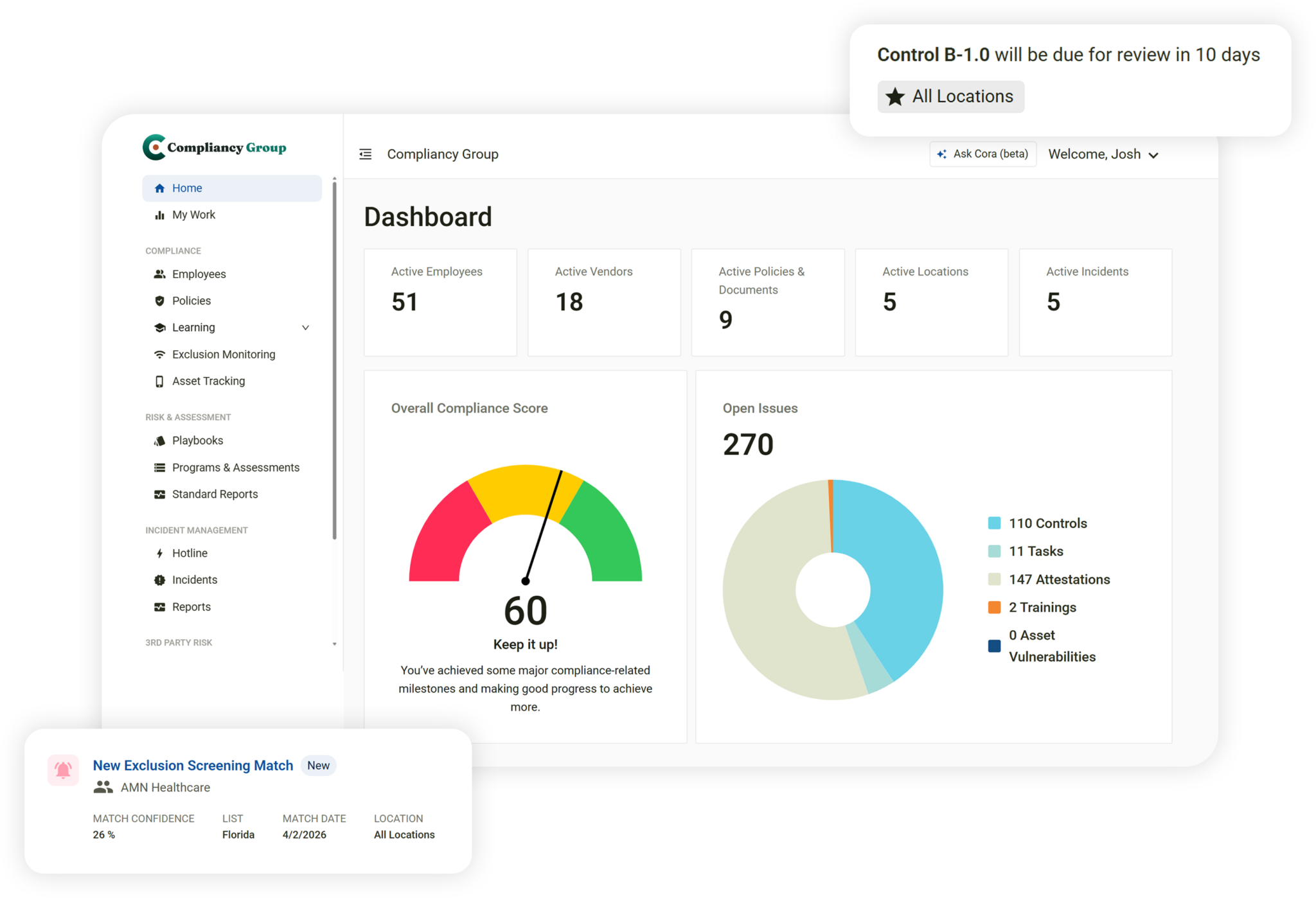
The Guard, Compliancy Group’s platform for healthcare compliance programs, brings the plan and the work together. Your policies, risk assessments, training, vendor and business associate agreement (BAA) tracking, and incident records live in one connected system, organized around OIG’s seven elements. That gives you a clear view of where compliance stands across your employees, locations, and vendors. The Conformance Score turns that view into one measure for each employee, location, and vendor, based on training, policy sign-offs, and exclusion checks, so you can see where to focus first [VERIFY: Conformance Score scope]. When an auditor asks for records, you can pull them without piecing them together by hand.
You don’t need to be a compliance expert or a large compliance team to use it. Ready-made policies and Compliancy Group’s Compliance Advisors help you along the way, so you can answer questions from leadership or an auditor with confidence. Software alone can’t ensure compliance, but it can make managing your program significantly easier. The Guard helps your team stay organized, track responsibilities, and maintain the records needed to demonstrate compliance.
To get started, download our free guide to risk assessment procedures in healthcare compliance. It includes a step-by-step checklist and ready-to-use templates. To see how your plan would work in The Guard, request a demo.