Ask Me Anything with Anne Marie Anderson: Where Do I Start?



Anne Marie Anderson is the Director of Product Content at Compliancy Group. She is a licensed attorney with more than 25 years of experience as a legal and compliance professional. In this series, "Ask Me Anything with Anne Marie Anderson" (AMA with AMA), she answers the questions at the top of your mind. Have something you'd like her to cover? Email [email protected] to get it addressed.


What is the question you get most often as an experienced Compliance professional from someone new to a compliance role or new to their current role?
Where do I start?
Compliance in general, but healthcare compliance in particular can seem overwhelming. So many regulations, so many pieces and parts of an organization touched, limited resources in terms of money, focus and time.
There is really no bad place to start. But I usually take two concurrent paths. I start with something that I think is likely an area of opportunity and also an area of success. During onboarding or even during interviewing for the new role, most compliance professionals ask a lot of questions. I usually put people on the spot and ask them their top five things that keep them up at night and those areas where they feel like the organization is doing well. You can also review the policies and judge potential weaknesses and strengths that way.
Your first month it is unlikely that you will be able to get an enterprise risk assessment rolling, just have conversations with people and use that as a starting point. Maybe mention something that was a challenge at a previous workplace and see how they think they are doing at that, or ask them what they remember from their last compliance training (if the answer is that there was no training you have a starting point).
For the area of success, approach the topic easily by letting the person in charge of the issue know that you are looking to gather evidence showing their efforts and highlight them. For areas of opportunity, I approach it more cautiously. Especially when you are new to an organization, people may feel uninclined to give you information that puts them or the organization in less than a good light. I think the most successful I have been in getting people to open up early in my efforts is to let them know I was trying to get a handle on where my resources and focus can benefit the organization most and maybe mention that I or a colleague had found some gaps in a certain compliance issue at another organization so I thought I would take a look here to see how this organization is tackling it. Another good approach is mentioning a recent news story on a particular topic that sparked my interest in seeing how this organization is handling something. Really anything that shows no one suggested to you that you start with them or their process.
The best advice I can give to any compliance team, even a team of one, is give yourself some grace. You cannot review every risk, revise every policy, address every issue on an annual basis except in a truly mature compliance environment. Compliance is everyone’s job – you are the leader that drives it, but if all compliance tasks are left to only a small part of an organization, it likely won’t succeed in meeting its obligations – that is not your failure.
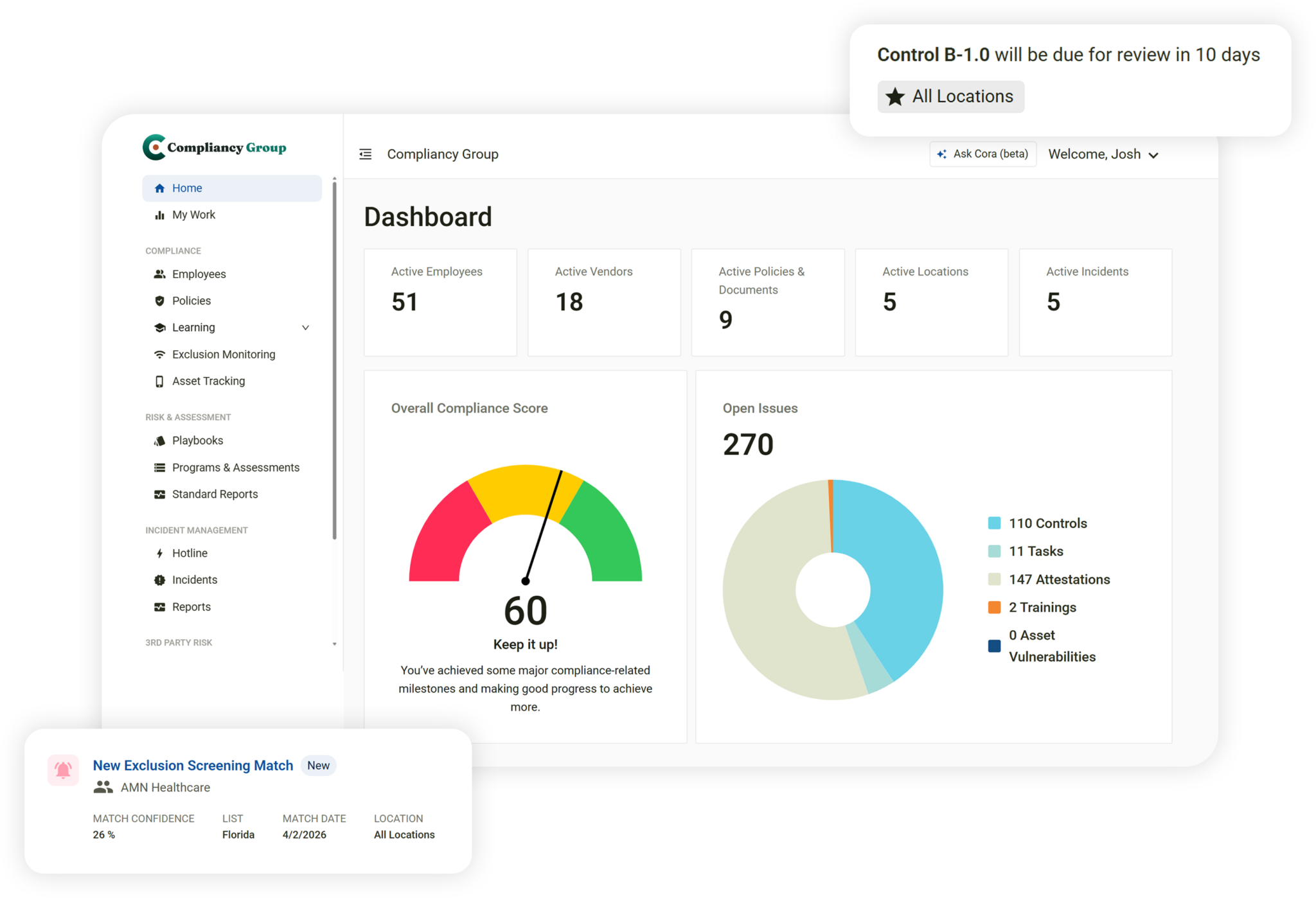
Do your best to assess high risks, put your effort into devising remediations and safeguards around those risks and documenting and evidencing the work and effort that goes on every day to meet obligations and requirements. Buy tools that help you do this. Compliance software has assessment and regulatory management tools like subject matter specific policies and controls, guidance, task management, evidence collection and reporting, along with employee exclusion monitoring, training and policy attestation.
Most organizations are doing more than they get credit for. Be the person to gather evidence beyond the expected. For example, thinking of training as only formal LMS training leaves out the most important part of most people’s training, like shadowing strong performers. Efforts to provide the best tools and environment where people can do the right thing and feel proud of their accomplishments are some of the best ways to encourage and evidence compliance. Make sure that your documentation reflects them and celebrates the people who model compliant practices.